English
 Français
 Türkçe
 한국어
한국어 Gaeilge
 لالعربية
 Azərbaycan
 Deutsch
 Tiếng Việt
 Filipino
 Беларуская
 Eesti
Eesti Български
 Íslenska
 Polski
 رسی
رسی Afrikaans
 Dansk
Dansk Русский
 Suomi
Suomi Kreyòl Ayisyen
 Nederlands
 Galego
 Català
 Čeština
 Hrvatski
 Magyar
 Latina
 Latviešu
 Lietuvių
 Română
 Bahasa Indonesia
 Bahasa Melayu
 Malti
Malti Македонски
 Norsk
Norsk Português
 日本語
日本語 Svenska
 Slovenščina
 Српски
 Slovenčina
 Kiswahili
 ไทย
ไทย हिन्दी
 Cymraeg
 יִדיש
יִדיש ئۇيغۇر تىلى
 اردو
اردو Українська
 Euskera
 Español
 עברית
עברית Ελληνικά
 Italiano

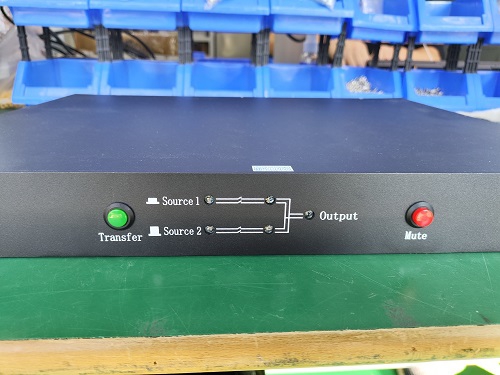
1. The necessity of configuring automatic load switching switch
Today's market economy and social activities are so dependent on information networks (the Internet, telecommunications networks, industrial automation control networks, government e-government websites, etc.) that even a "network paralysis" of just a few minutes may cause It brings immeasurable losses to the sales, business management, normal operation of social life, reputation, and public image of companies, enterprises and administrative agencies. In view of the high degree of "timeliness" that the public expects from the normal operation of the "information network", the UPS power supply system responsible for supplying power to it must have the ability to provide 100% "high availability" power supply. At present, one of the commonly used technical measures is to configure "N+1" UPS redundant parallel systems in various important information network rooms to ensure that various network equipment can process/transmit safely and reliably. /Storage data and various information materials to create an excellent power operating environment.
Years of operation practice have proven that the “N+1” UPS redundant parallel system has the following technical advantages:
Enhance the "fault tolerance" function of the UPS power supply system: During the operation of the UPS redundant parallel system composed of "N+1" UPS, if one of the UPSs "fails" for any reason, the remaining N units The UPS has sufficient "load capacity" to provide pure, regulated UPS inverter power to the connected network equipment, thereby ensuring the safe operation of various network equipment. This means that for such a UPS redundant power supply system with "fault tolerance" function, even if a UPS fails for some reason, it can still provide 100% "high availability" to its load. "High-quality power supply.
Improve the reliability of the UPS power supply system: For example, the mean time between failures (MTBF) of the "1+1" parallel system is about 6 times that of a single UPS system. If we also consider that the MTBF value of today's medium and large UPS has reached as high as 400,000-500,000 hours, the MTBF value of the "1+1" UPS redundant power supply system can reach about 2.5 million hours. Compared with the "availability rate" of 99.9% of ordinary mains power supply, it can increase the "availability rate" of the UPS power supply system to more than 99.99997%. It can be seen from this that it plays a huge role in improving the reliability of the power supply system. Improving the maintainability of the UPS power supply system: It allows "off-line" regular maintenance/troubleshooting operations to be performed on a single UPS unit in a UPS parallel system under the condition that the UPS inverter power supply is supplied.
Although after configuring the "N+1" type UPS redundant parallel system, the power supply environment of the information network can be greatly improved. However, in recent years, investigations into the operating conditions of today's IDC computer rooms have found that relying solely on the "N+1" type UPS redundant parallel system cannot 100% ensure that there will never be a "power outage" at its output end. ACCIDENT. Relevant statistical data proves that due to improper selection of UPS models or improper design of the input power distribution system/output power distribution system, "short power outages ranging from tens of milliseconds to several seconds" occur in the UPS redundant parallel system. "Or "long power outage" accidents lasting more than a few minutes still occur from time to time (note: the relative proportion of such failures is very low).
As we all know: During the operation of the "information network", if an "instant power supply interruption" fault occurs for more than 20 milliseconds, it may cause "power on self-check" malfunctions of network equipment such as servers, small computers, and gateways. (At this time, the server will "automatically shut down" in an instant, and then automatically perform a "restart" operation in a very short period of time. In this way, it will inevitably cause damage to the operating system of the information network and the user's application software. loss of critical data), resulting in a "network paralysis" accident.
Relevant statistics prove that once this situation occurs, it often takes "time-consuming" to restore the information network to normal operation, ranging from dozens of minutes to several hours, resulting in the impact of the "network paralysis" accident being Expand dramatically. For example: When the telecommunications network of a telecommunications company was in operation, due to a "short power interruption" of about 3 seconds in the UPS power supply system, its billing system and automatic query of telephone numbers and other key systems stopped working, resulting in millions of losses. Yuan's operating losses and a large number of complaints from users. One of the effective technical ways to eliminate the occurrence of such unfortunate accidents is to configure the UPS "dual bus output" power supply system as shown in Figure 1.